Back to Insights
Software Development 6/18/2026 6

WordPress vs. Next.js: Which Architecture is Best for Your Kenyan Business Website?

Author

Royoltech Team

Editor

Main

When launching a new business website, e-commerce storefront, or corporate portal in Kenya, one of the first major decisions you will face is architectural: What stack should we build this on? For over a decade, the default answer for most businesses has been WordPress. But as the internet evolves and user patience wears thin, modern frameworks like Next.js have emerged to challenge the old guard.

If you are trying to decide whether to go with a traditional WordPress setup or build a custom Next.js application, let’s look at how they compare across performance, security, SEO, and maintenance.

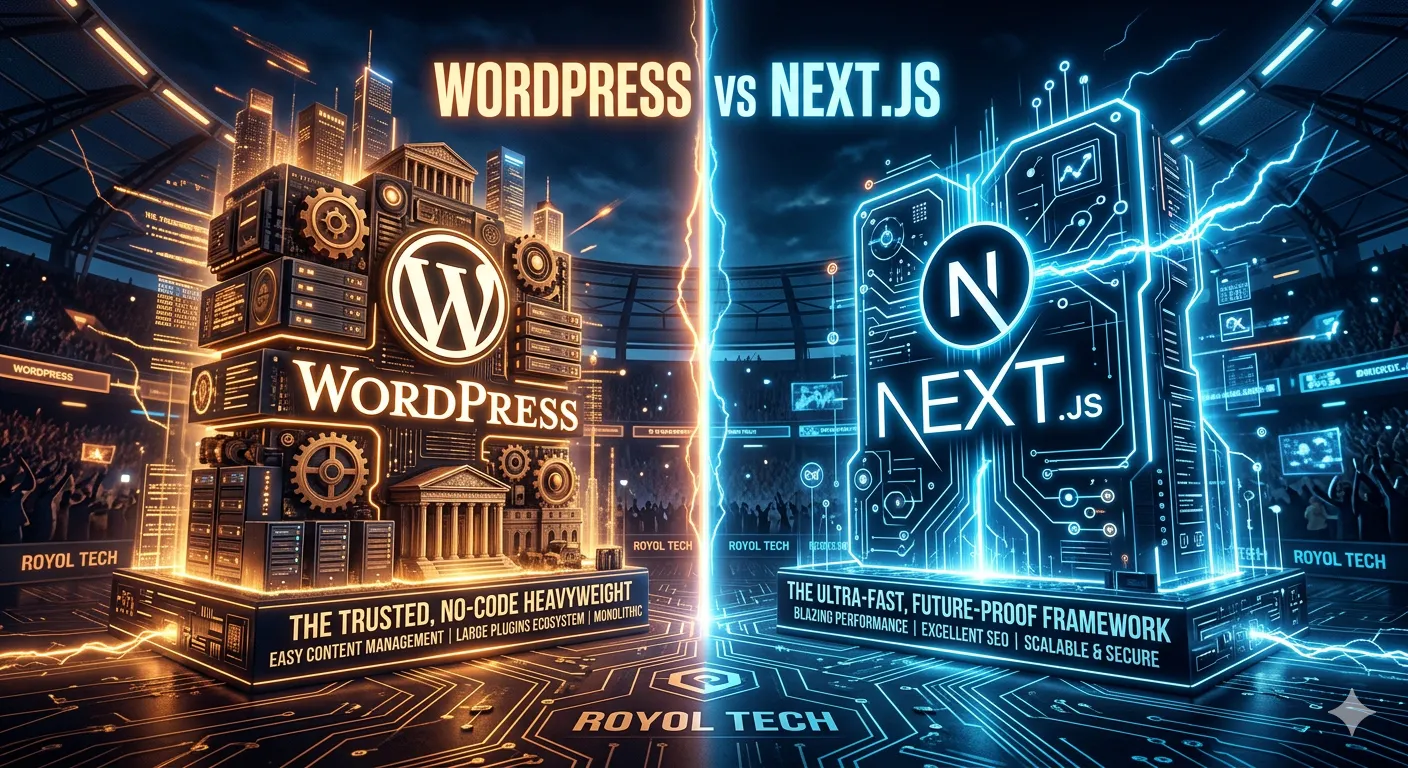
WordPress: The Trusted, No-Code Heavyweight

WordPress powers over 40% of all websites on the internet. It is a traditional Monolithic Content Management System (CMS), meaning the database, backend administration dashboard, and visual frontend are all tightly bundled together.

  • Speed & Deployment: WordPress relies heavily on server-side rendering via PHP. Every time a user visits your site, the server queries a MySQL database to construct the page. Without heavy caching layers, this can make sites feel sluggish—especially on standard local mobile networks (3G/4G).
  • Ease of Use: This is where WordPress shines. Non-technical staff can log in, write a blog post, or update product prices via a visual editor without touching a single line of code.
  • The Plugin Ecosystem: Need a payment gateway integration like M-Pesa, a contact form, or an SEO optimization tool? There is a plugin for almost everything. However, over-relying on plugins bloat your site and slow down load times drastically.
  • Next.js: The Ultra-Fast, Future-Proof Framework

    Next.js is a cutting-edge React-based framework used by global giants like TikTok, Netflix, and Nike. It uses a headless or decoupled architecture, where the frontend of your website is completely separate from the backend data source.

  • Blazing-Fast Performance: Next.js utilizes Static Site Generation (SSG) and Incremental Static Regeneration (ISR). This means pages are pre-rendered into lightweight, raw HTML/CSS files during build time and served globally via a Content Delivery Network (CDN). The site loads instantly, providing an elite user experience even on unstable mobile connections.
  • Flawless SEO out of the Box: Unlike traditional Single Page Applications (SPAs) that struggle with search engine crawlers, Next.js handles server-side optimization perfectly. Google rewards fast, accessible websites, giving Next.js apps a massive organic search advantage.
  • Developer Freedom & Security: Because there is no direct database connection or standard dashboard exposed to the public internet, Next.js sites are incredibly secure. They are virtually immune to the common SQL injections and bot vulnerabilities that plague poorly maintained WordPress sites.
  • Head-to-Head Comparison

    Ah, got it! My bad—I'll swap out that Markdown table structure entirely so you can seamlessly paste the Head-to-Head breakdown straight into Prismic's standard paragraph and list blocks without breaking your layout.

    Here is the revised comparison section formatted cleanly as subheadings and bullet points:

    Head-to-Head Comparison

    1. Development Speed

  • WordPress: Fast. You can leverage pre-built themes, templates, and plugins to go live in a matter of days.
  • Next.js: Moderate. Requires custom frontend coding and component architecture from scratch, but gives you absolute design freedom.
  • 2. Page Load Speed

  • WordPress: Average to Slow. Relying heavily on database queries and multiple third-party plugins can bloat your site and slow down local mobile loading times.
  • Next.js: Extremely Fast. Utilizes static site optimization to serve pages instantly via global CDNs, delivering peak performance even on unstable networks.
  • 3. Security Risk

  • WordPress: High. Its extreme popularity makes it a prime target for automated bots. It requires constant updates to core files, themes, and plugins to prevent vulnerabilities.
  • Next.js: Very Low. Because there is no exposed database connection or traditional admin login URL on the public-facing site, it is incredibly secure out of the box.
  • 4. Content Editing

  • WordPress: Native and excellent. Features a highly intuitive, built-in dashboard that non-technical staff can comfortably use to update text, media, and blogs immediately.
  • Next.js: Requires integration. It needs to be hooked up to an external headless CMS (like Prismic) to allow your team to publish and manage content visually.
  • 5. Scalability

  • WordPress: Heavy. Traffic spikes can easily overload your server or hosting package unless you invest heavily in advanced server caching layers.
  • Next.js: Infinite. Because pages are pre-rendered into static files, the site can handle massive traffic surges seamlessly with zero server strain.

  • The Verdict: Which One Should You Choose?

    Choose WordPress if...

    You need a standard informational brochure website, a straightforward blog, or a simple e-commerce store that needs to go live quickly. If your internal team needs to make frequent text updates and you don't have dedicated software engineers on standby, WordPress offers the path of least resistance.

    Choose Next.js if...

    You are building a high-traffic platform, a complex web application, an algorithmic trading dashboard, or an enterprise-grade business site where performance directly impacts revenue. If milliseconds matter to your conversion rates and you want iron-clad security that won't get hacked by automated web bots, Next.js is the superior choice.

    The Best of Both Worlds: You don't always have to choose! At Royol Tech, we frequently build Headless WordPress systems. We use WordPress solely as a backend dashboard for your team to type content, but we code the actual visible website in Next.js. This gives your staff the easy editing power of WordPress, while your customers experience the absolute speed and safety of Next.js.

    Need Help Choosing?

    Whether you need a quick-to-market WordPress site or a custom, high-performance Next.js application integrated with financial APIs, our engineering team at Royol Tech is ready to bring your vision to life. Get in touch with us today to discuss your project requirements!

    Share this article: